This article contains affiliate links (PR).
Last checked: November 13, 2026. License rules are from the National Police Agency and JAF (Japan Automobile Federation); rental terms are from each company’s English site.
Rent a car in Hokkaido in winter only if you already drive on snow and ice at home and can keep to main roads in daylight. If you have never driven on snow, Sapporo, Otaru, Hakodate and the main ski resorts are reachable by train or bus, and rural sights by day tour. To rent at all, you need an International Driving Permit issued under the 1949 Geneva Convention (or, for six countries, a Japanese translation of your license) plus your passport.
- Quick answer
- Can you drive in Japan with your license?
- What a winter rental car in Hokkaido comes with
- Why ice is the real danger: JAF braking distances
- How to drive on Hokkaido’s winter roads
- Which Hokkaido roads are hardest in winter
- Getting around Hokkaido in winter without a car
- If something goes wrong
- Getting there
- Tips for international visitors
- FAQ
- Summary
Quick answer
Whether to rent a car in Hokkaido in winter depends on your snow-driving experience, where you are going, and the month. Find the row closest to your trip.
| Your situation | What to do |
|---|---|
| Never driven on snow; staying in Sapporo, Otaru or Hakodate | Do not rent. JR trains, the Sapporo subway and buses cover these cities. |
| Never driven on snow; want rural sights such as Biei | Do not rent. Join a day bus tour from Sapporo or Asahikawa, or hire a taxi for the day. |
| You drive in snow every winter at home; daytime trips on main roads | Renting is reasonable. Confirm 4WD, damage cover and pickup hours when you book. |
| Your plan crosses mountain passes in January or February | Change the route. Take JR or a highway bus between cities and rent only at your destination. |
| Your IDP was issued under the 1968 Vienna Convention, or you have no IDP | You cannot drive in Japan with it. See the license rules below. |
Rental prices change with dates and demand, so compare two companies for the same pickup time and check what the winter seasonal charge adds.
Klook lists the rental companies in Chitose, the city where New Chitose Airport is, in one search, and some listings are marked as having English service. The list page does not show winter tires or 4WD, so open the plan details before you book and check both: Chitose car rentals on Klook.
Can you drive in Japan with your license?
Japan accepts two kinds of foreign permission to drive: an International Driving Permit (IDP) issued under the Geneva Convention on Road Traffic of September 19, 1949, or, for licenses from Switzerland, Germany, France, Belgium, Monaco and Taiwan, your original license with a Japanese translation. JAF states that IDPs issued under other treaties, such as the 1968 Vienna Convention, are not valid in Japan. Either document lets you drive for up to one year from your entry into Japan, and only while your home license is valid.
| Where your license is from | What you carry while driving |
|---|---|
| Switzerland, Germany, France, Belgium, Monaco or Taiwan | Your original license plus a Japanese translation of it |
| A country that issues IDPs under the 1949 Geneva Convention | Your IDP (the paper booklet); rental companies also ask for your passport |
| A country that issues IDPs only under another treaty | That IDP is not valid in Japan; plan the trip without a car |
JAF issues the Japanese translations and takes applications on its online translation site. JAF also notes that police may ask drivers using a translation for their passport, to check how long they have been in Japan.
Rental counters check the IDP itself and refuse one that fails any point. Nippon Rent-A-Car lists these (notice of August 29, 2025):
- A paper booklet in the Geneva Convention format, 148 mm by 105 mm. Copies, digital versions and A4 sheets are not accepted.
- Issued by a party to the Geneva Convention, with the date September 19, 1949 printed on it.
- Issued less than one year ago.
- Surname, first name, place and date of birth, and address all filled in.
- A stamp or sticker for the vehicle category you reserved, and your photo.
Toyota Rent a Car also asks for your passport at the counter. If you enter Japan through the automated immigration gates, ask the staff there for a landing stamp: Toyota says it cannot rent you a car if your date of entry cannot be confirmed.
Sources: JAF / National Police Agency / Nippon Rent-A-Car / Toyota Rent a Car
What a winter rental car in Hokkaido comes with
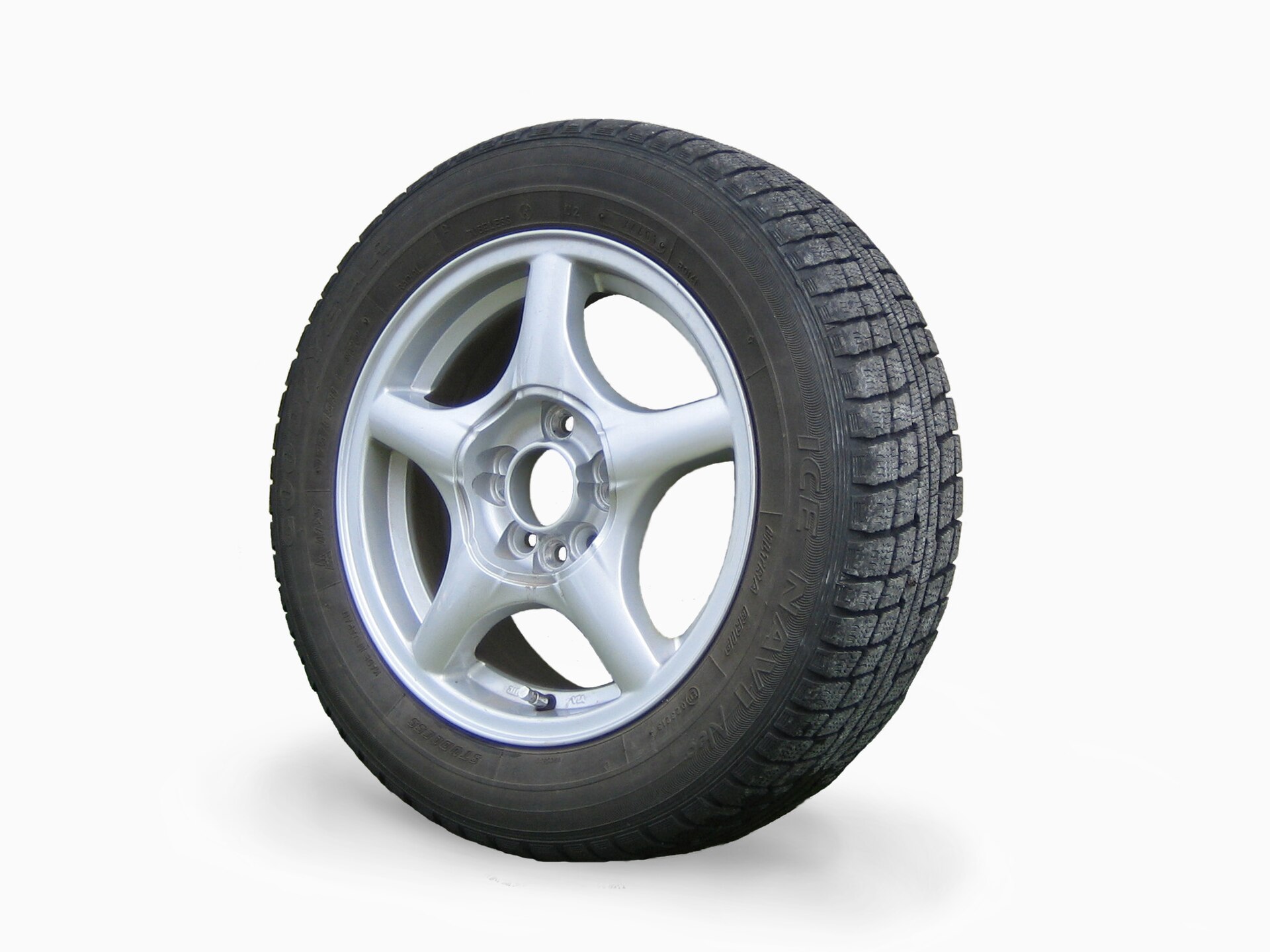
Winter tires come as standard on cars rented in Hokkaido in winter at the major companies, so you do not need to request them. Toyota Rent a Car fits them at all Hokkaido shops from November 1 to May 5, and Nippon Rent-A-Car from November 1 to April 20 (by pickup date); both add a winter seasonal charge. 4WD is not automatic at every company: Toyota sells it as an option.
The table uses Toyota Rent a Car’s English pages as one example. Other companies set their own prices and cover.
| Item | Toyota Rent a Car, Hokkaido (as of November 13, 2026) |
|---|---|
| Winter tires | Standard at all Hokkaido shops, November 1 to May 5; seasonal rates apply |
| 4WD | ¥1,650 per 24 hours for passenger classes; not at every shop |
| Collision Damage Waiver | ¥1,100 per 24 hours; waives the ¥50,000 deductible for property damage and for damage to the car |
| Non-Operation Charge (NOC) | ¥20,000 if the car can be driven back, ¥50,000 if not; waived by the Double Protection Package, ¥550 per 24 hours on top of the waiver |
| ETC card (expressway tolls) | ¥550 per rental; tolls are paid at return, by card or cash |
| Navigation | Multilingual navigation in passenger classes; set destinations by phone number or MAPCODE |
| JAF membership certificate | ¥550 per rental; JAF road service with phone interpretation |
The NOC is what a company bills for the days a damaged car cannot be rented out, separate from the repair. Scrapes and getting stuck are more likely on snow, so price the waiver and the NOC cover together when you compare companies.
JAF suggests a car with ESC (electronic stability control) for snowy roads. Before you drive off, Toyota’s winter checklist covers snow on the roof, snow and frost on the windshield, clear side mirrors, the wipers and the fuel level. Look for a snow brush and ice scraper in the car as well.
Sources: Toyota: winter tires / Toyota: options / Toyota: insurance / Nippon Rent-A-Car: winter tires / JAF: snow and ice
Why ice is the real danger: JAF braking distances
Ice matters more than snow because braking distance depends on the road surface. In a JAF test braking hard from 40 km/h with ABS (average of three runs), a car needed 20.2 m to stop on packed snow and 84.1 m on sheet ice, about four times as far. Black ice, which looks like a wet road, took 69.5 m.
| Road surface | Braking distance from 40 km/h |
|---|---|
| Wet road (rain) | 11.0 m |
| Packed snow | 20.2 m |
| Black ice | 69.5 m |
| Sheet ice | 84.1 m |
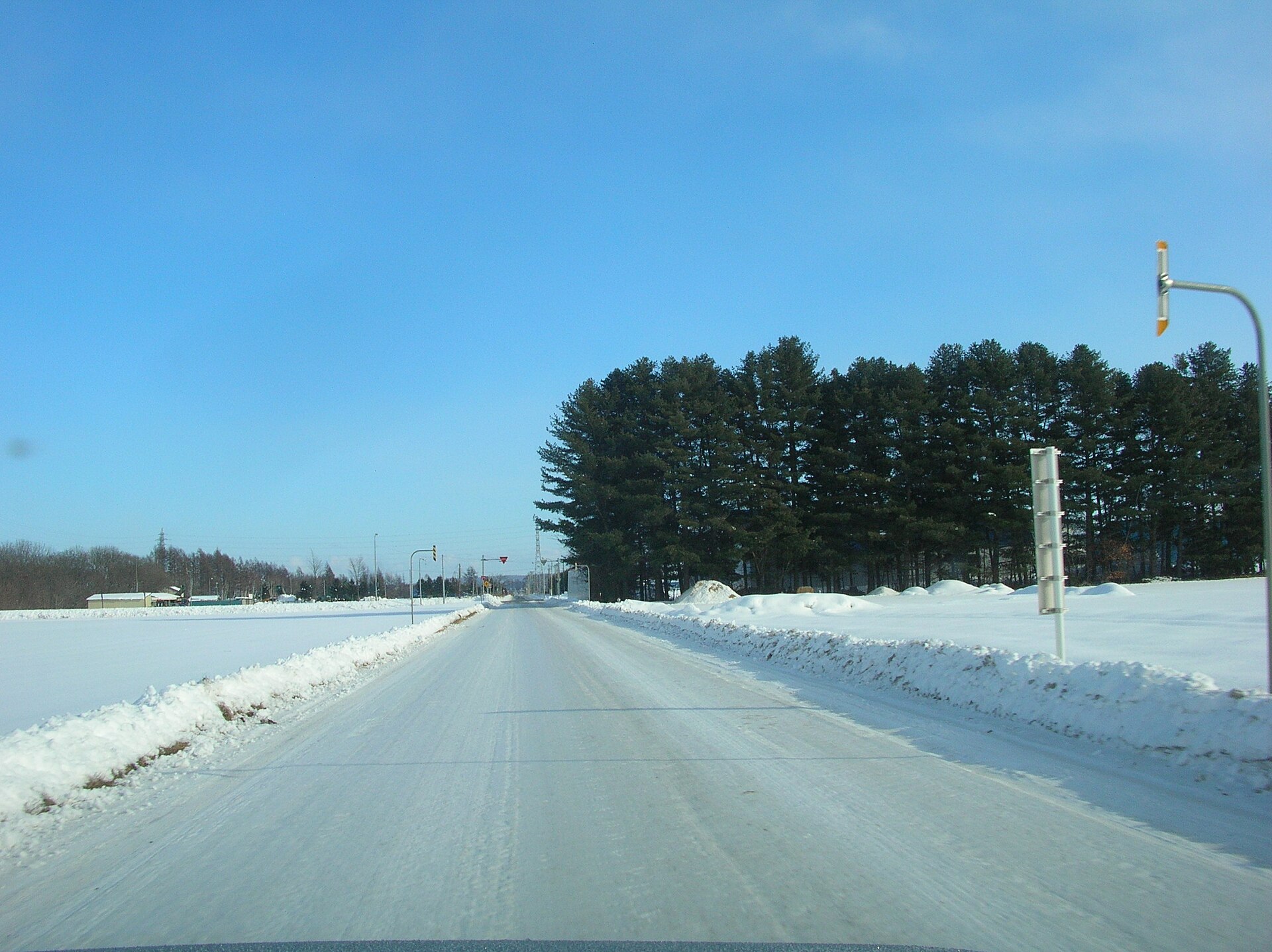
Black ice
Black ice is a thin layer of ice on a road that looks merely wet. In the JAF test the two surfaces looked almost the same, yet the braking distances differed by more than 50 m, and JAF warns black ice is even harder to spot at night. JAF names bridges, windy overpasses and tunnel entrances and exits as the most dangerous places; Toyota adds shaded roads, intersections and mountain roads.
Polished ice at intersections
Cars stopping and starting polish the packed snow before a stop line into a mirror-smooth surface, which Japanese drivers call “mirror burn”. JAF lists the approach to stop lines as a slippery spot in town. Start slowing well before the intersection and brake gently.
Whiteout
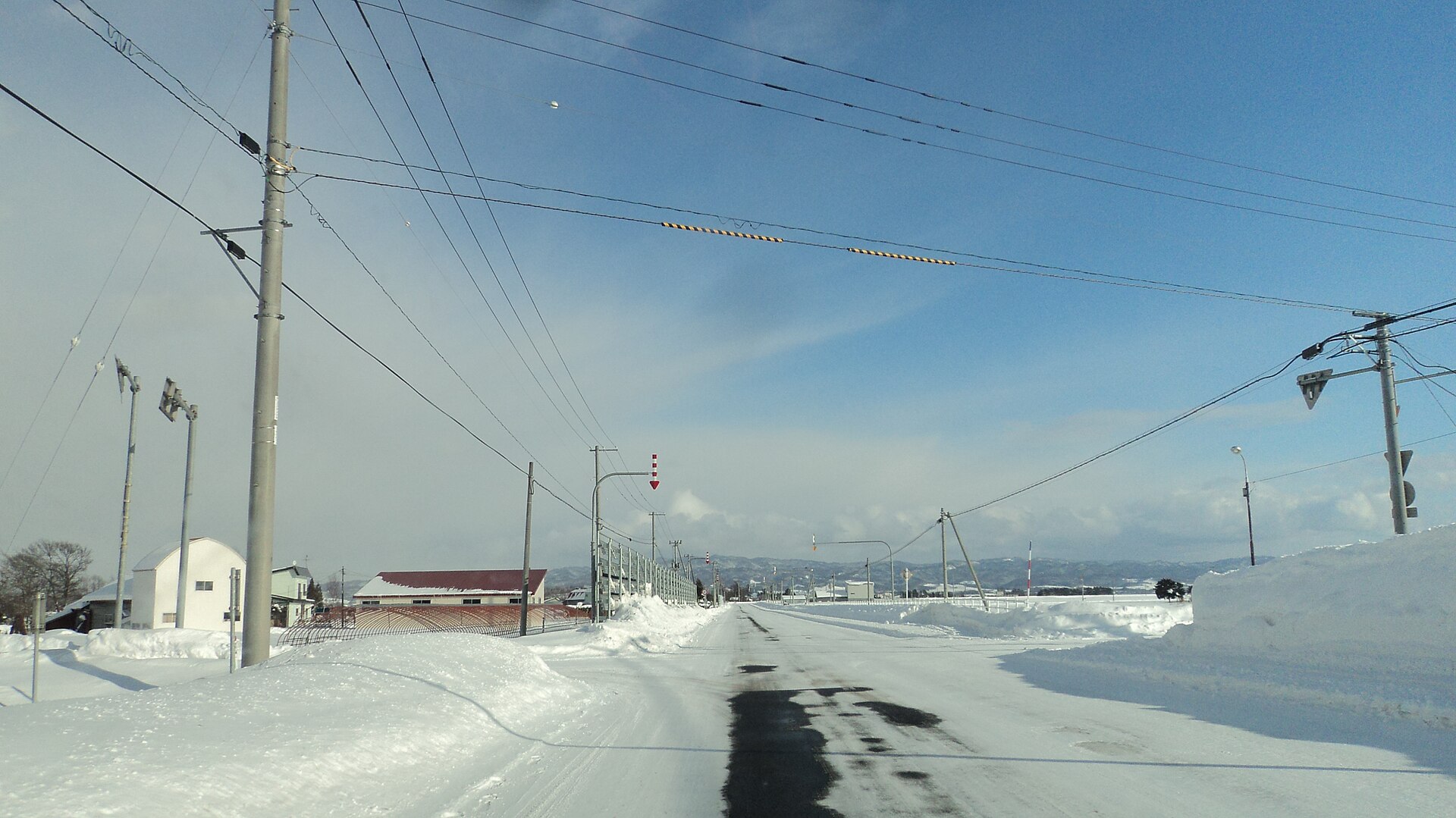
A whiteout is a sudden loss of visibility in a blizzard or blowing snow, when the road can no longer be told apart from its surroundings. The best defense is not to be on the road: check the forecast and stay put on stormy days. If it happens while you drive, JAF advises turning on your hazard lights and stopping at a safe place. Pull into a roadside station (michi-no-eki) or a parking area rather than stopping in the lane, where a following car may not see you. Where snow hides the shoulder, follow the arrows and reflective poles that mark the road edge.
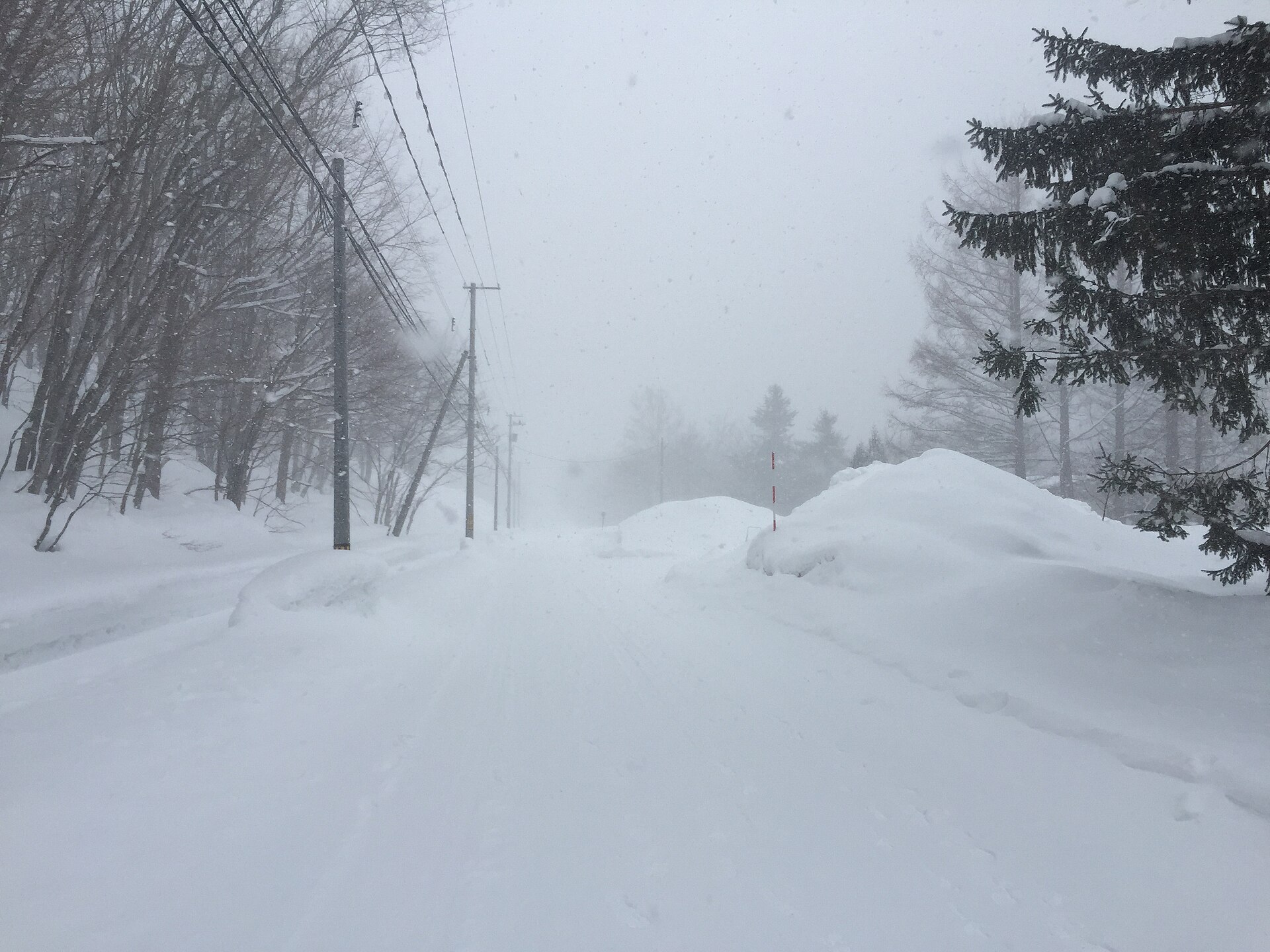
Ruts after heavy snow
After heavy snowfall, deep ruts form in town streets until the plows clear them. Crossing a rut at an angle can pull the steering, so change lanes as little as possible and drive slowly in the ruts.
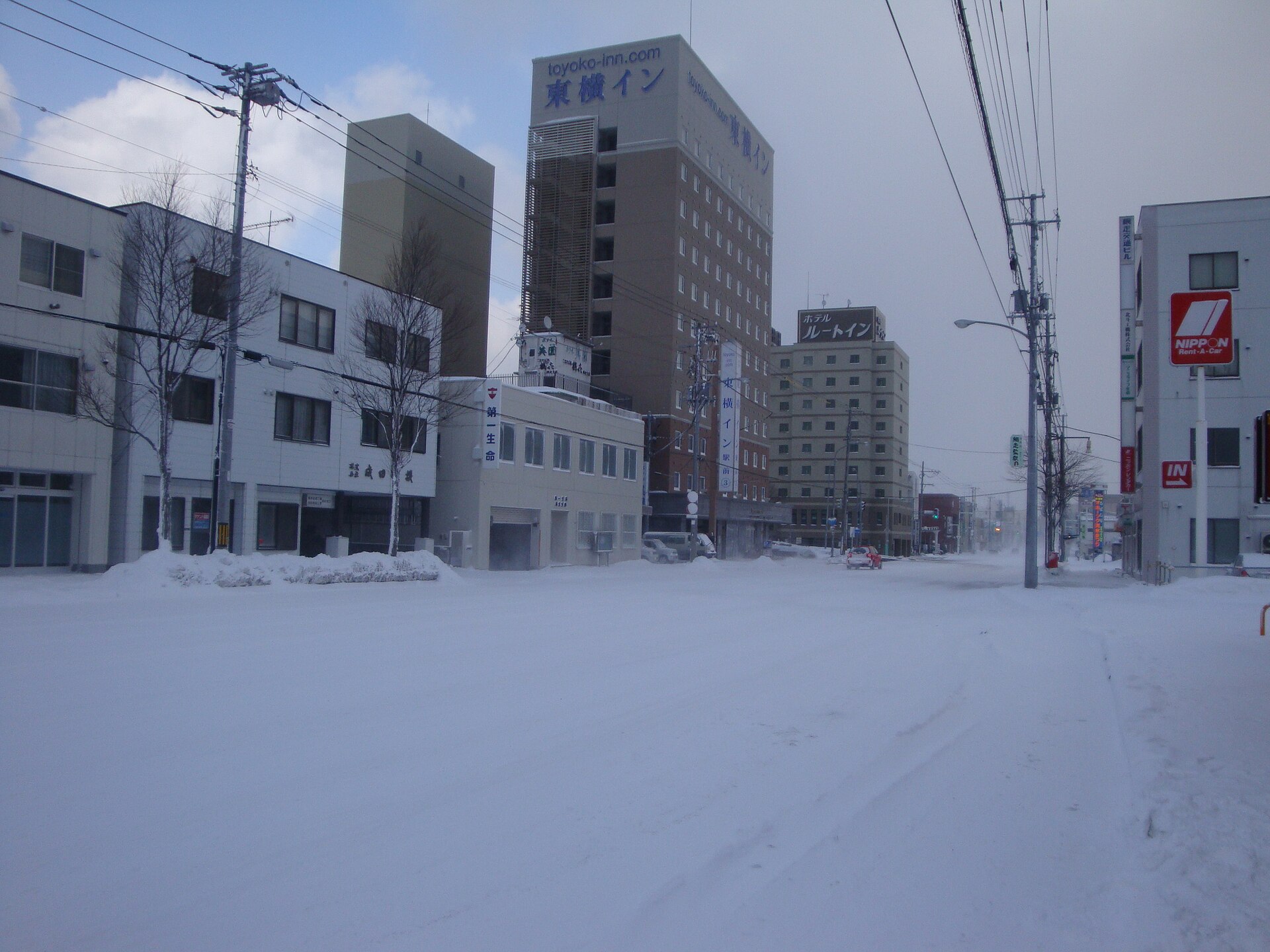
Sources: JAF user test: black ice (Japanese) / JAF: snow and ice / Toyota: snowy roads
How to drive on Hokkaido’s winter roads
Three habits prevent most winter trouble on Hokkaido roads: no sudden steering, braking or acceleration; a following distance far longer than on a dry road; and a schedule that has you parked before dark. JAF and Toyota both list the first two. The third matters because the sun sets in Sapporo around 16:00 in December.
| Date | Sunrise in Sapporo | Sunset in Sapporo |
|---|---|---|
| December 15, 2026 | 6:59 | 16:00 |
| January 15, 2027 | 7:03 | 16:24 |
| February 15, 2027 | 6:33 | 17:05 |
Eastern Hokkaido gets dark earlier: in Nemuro the sun sets at 15:43 on December 1. Plan to finish each day’s drive by about 15:00 in December and January.
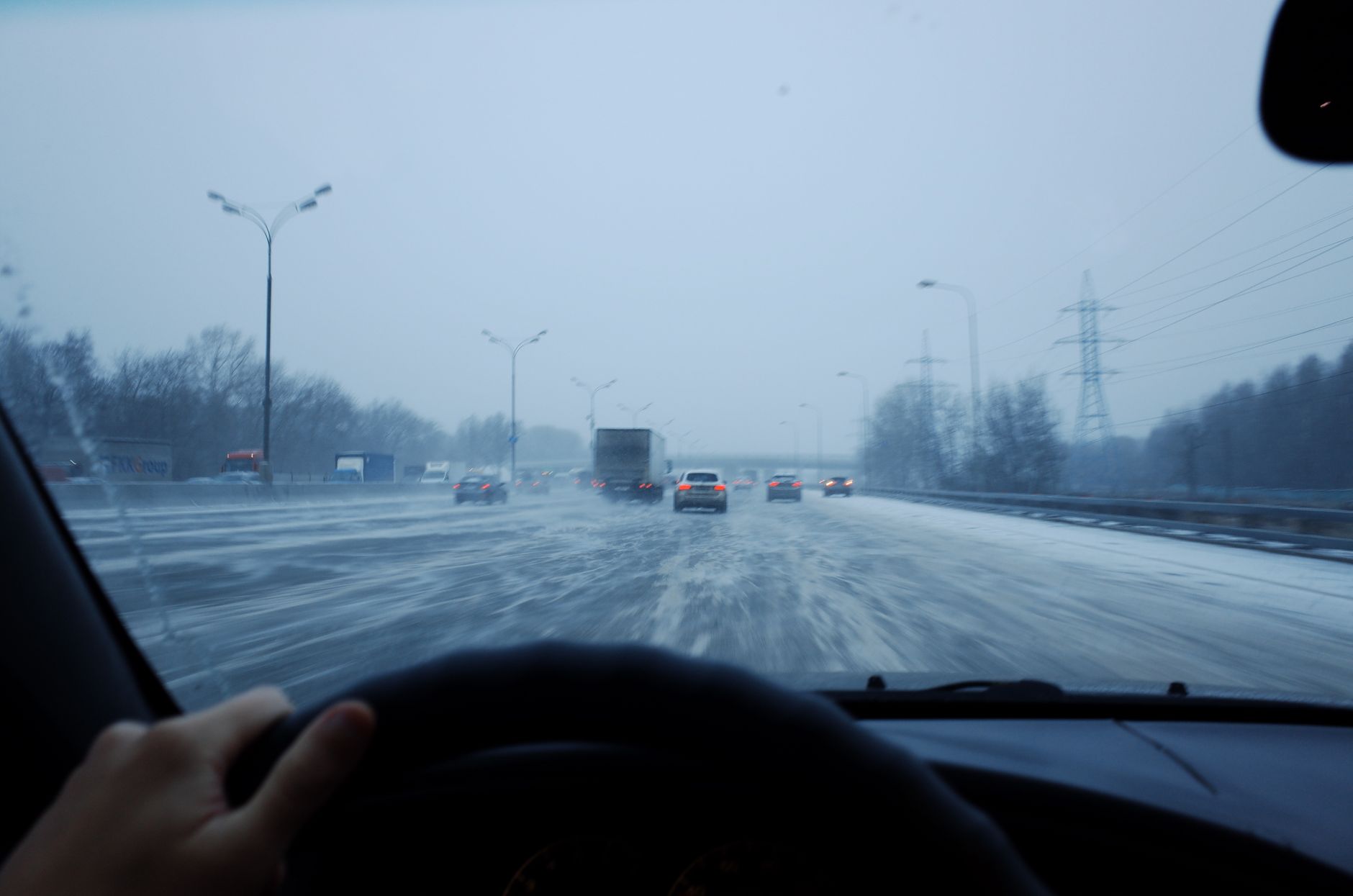
Japan drives on the left. A sign reading 止まれ (tomare) means you must come to a full stop. When you pull away on snow, press the accelerator gently, as JAF advises.
4WD helps you move, not stop. In a JAF test on packed snow with new winter tires, only the 4WD cars climbed a 20% slope, but on the flat all four cars stopped from 40 km/h in 20–22 m, and on a 9% downhill the heavier 4WD cars needed about 35–40 m against about 29–33 m for the 2WD cars.
Sources: National Astronomical Observatory of Japan (Japanese) / JAF user test: 4WD and 2WD (Japanese) / National Police Agency
Which Hokkaido roads are hardest in winter
Mountain passes are the hardest roads in Hokkaido in winter, because steep grades, sharp curves and sudden weather changes come together there. Expressways are plowed and monitored, so they are usually easier, but they close in blizzards. City streets are slow but demand attention at intersections and in ruts.
| Road type | Difficulty | What to expect |
|---|---|---|
| City streets (Sapporo and other towns) | Medium | Low speeds, but polished ice at intersections, ruts and pedestrians |
| Main national roads on the plains | Low to medium | Wide and easy, but traffic moves fast and some stretches have blowing snow and drifts |
| Expressways (such as the Do-O Expressway) | Low to medium | Plowed and monitored; can close during blizzards |
| Mountain passes | High | Nakayama Pass (Route 230), Nissho Pass (Route 274), Sekihoku Pass (Route 39): steep grades, sharp curves, fast-changing weather |
Any road can turn difficult in a storm. Let JR or a highway bus handle the long legs between cities, use the car only around your base, and keep the daily distance short.
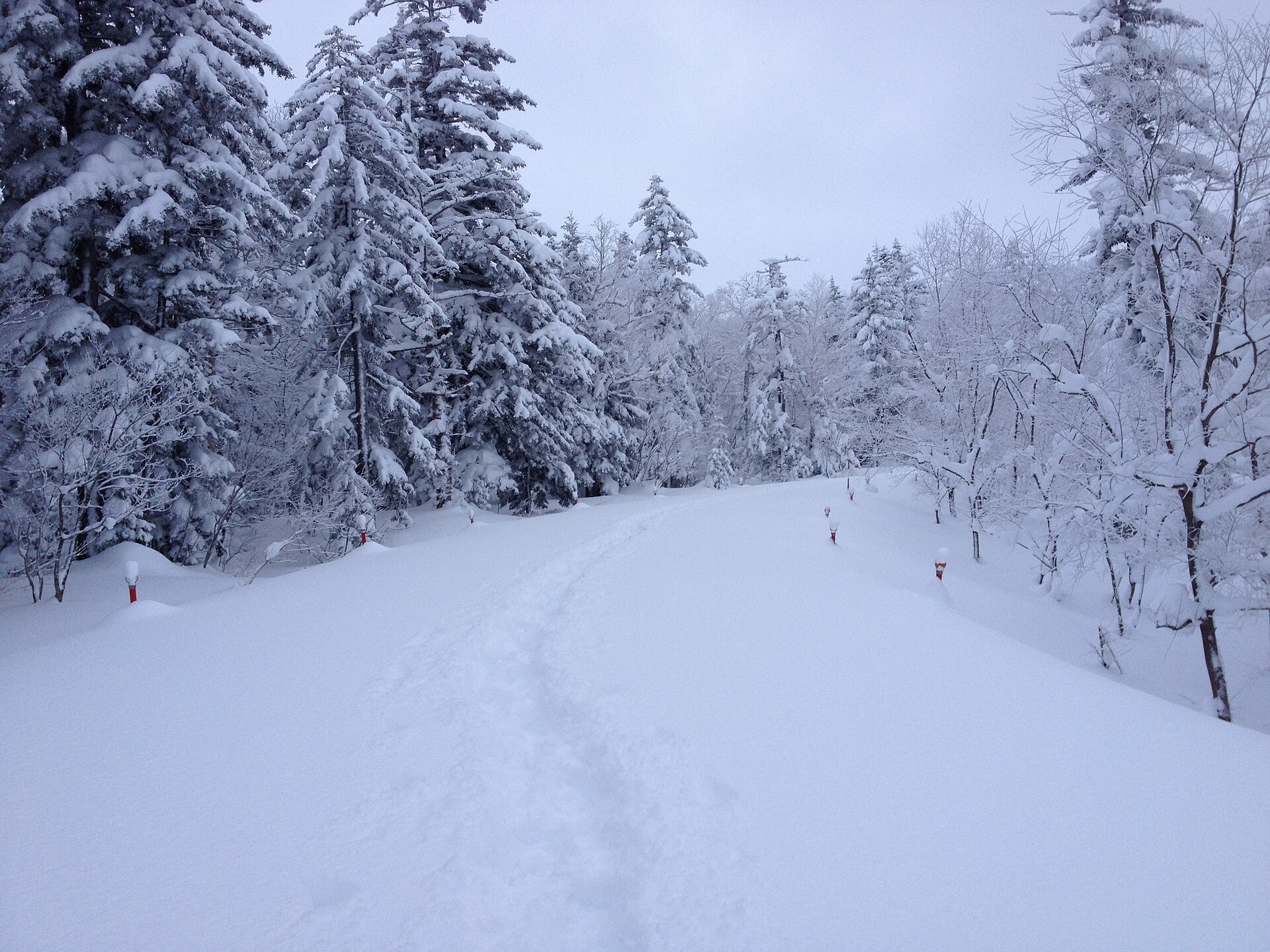
For forecasts in English, the Japan Meteorological Agency’s snow page maps snow depth and expected snowfall. Road closures and live cameras are on the national Road Information Provision System (道路情報提供システム), which is in Japanese; route numbers are easy to match on its map.
Sources: JMA: Analysis and Forecasts of Snow / Road Information Provision System (Japanese)
Getting around Hokkaido in winter without a car
Most of Hokkaido’s standard winter destinations can be reached without driving. Sapporo, Otaru, Hakodate, Asahikawa (for Asahiyama Zoo) and Noboribetsu Onsen are on JR lines with bus connections, and limited express trains and highway buses link the cities. Storms can cancel trains and buses too, so keep a spare day either way.
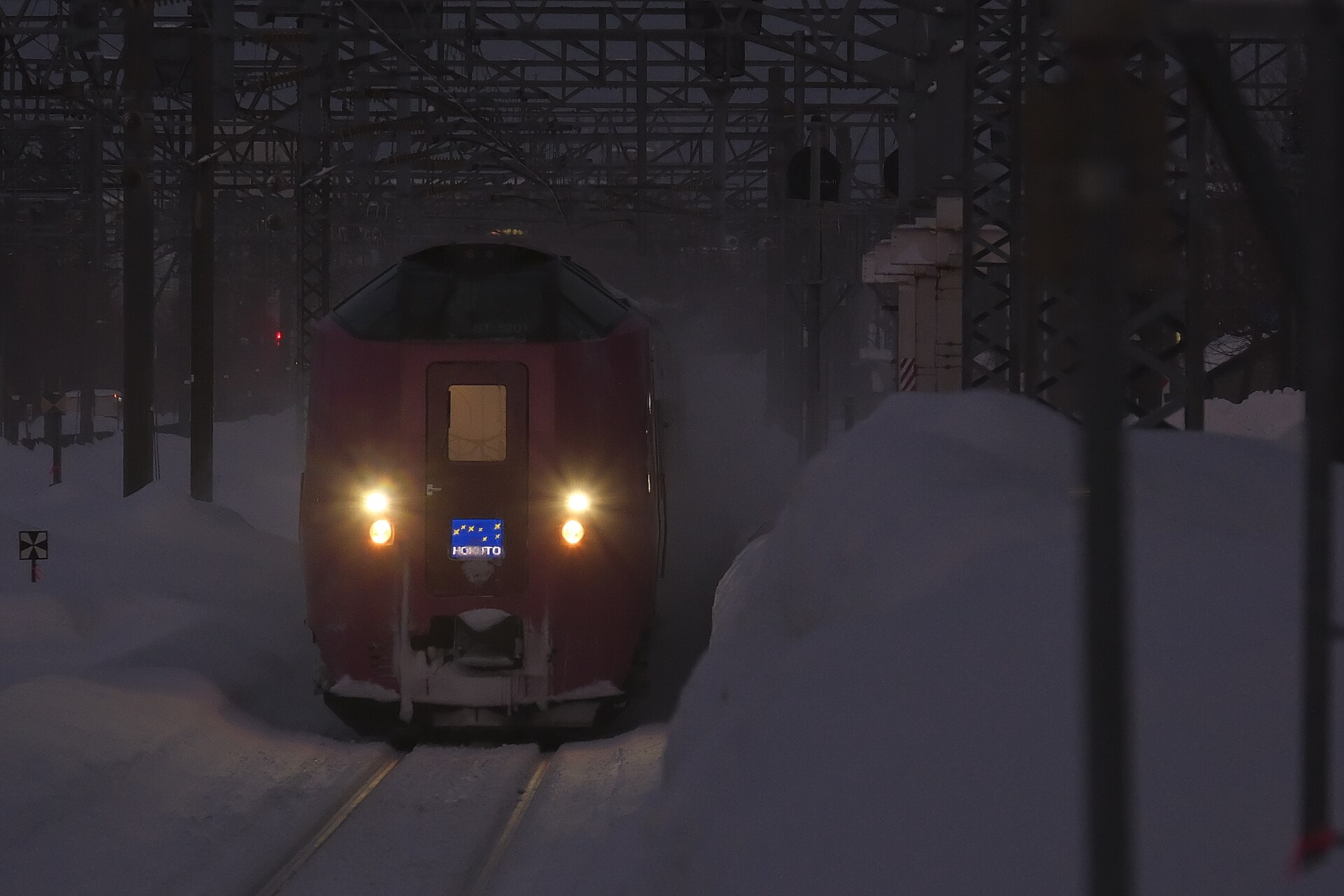
For skiing, see New Chitose Airport ski buses to Niseko, Rusutsu, Furano and Tomamu and where to stay in Niseko. For the Snow Festival, a hotel near the sites removes the need for a car: Sapporo Snow Festival hotels near Odori and Susukino. For drift ice, when to see drift ice in Hokkaido covers reaching Abashiri from Memanbetsu Airport instead of a long drive from Sapporo. For rural sights, day bus tours from Sapporo and Asahikawa run in winter.
One example is a day tour from Sapporo to Asahiyama Zoo and the Blue Pond light-up, with the round-trip bus and zoo admission included. It is a join-in group tour shared with Japanese travelers and takes about 9 hours 30 minutes; lunch is at your own cost. Klook lists the tour in Chinese, English and Japanese and notes that on some days a Japanese guide gives the English and Chinese commentary through a translator. The schedule changes after February 1, so check the package details for your date.
Between cities, the JR Hokkaido Rail Pass gives unlimited rides on JR Hokkaido lines, except the Hokkaido Shinkansen, for 5, 7 or 10 consecutive days. JR Hokkaido lets anyone with a non-Japanese passport use it, but the Klook product excludes non-Japanese passport holders with permanent residence in Japan. Under Klook’s terms, the voucher has to be exchanged for the pass at an official exchange office in Japan within 90 days of purchase, and the pass has to start within 30 days of the exchange; bring your passport, since JR Hokkaido does not accept a residence card or a copy. JR Hokkaido does not extend or refund a pass after its start date when trains are canceled, so a day lost to a storm still counts.
Source: JR Hokkaido: Rail passes
If something goes wrong
After an accident, a breakdown or getting stuck in a rental car, call the rental company’s emergency number first; it is on your rental papers. JAF Road Service answers 24 hours a day on 0570-00-8139 or #8139 and offers free phone interpretation in 24 languages, including English. Call 119 for injuries, and report any traffic accident to the police on 110, which JAF says you must do.
If you get stuck in snow
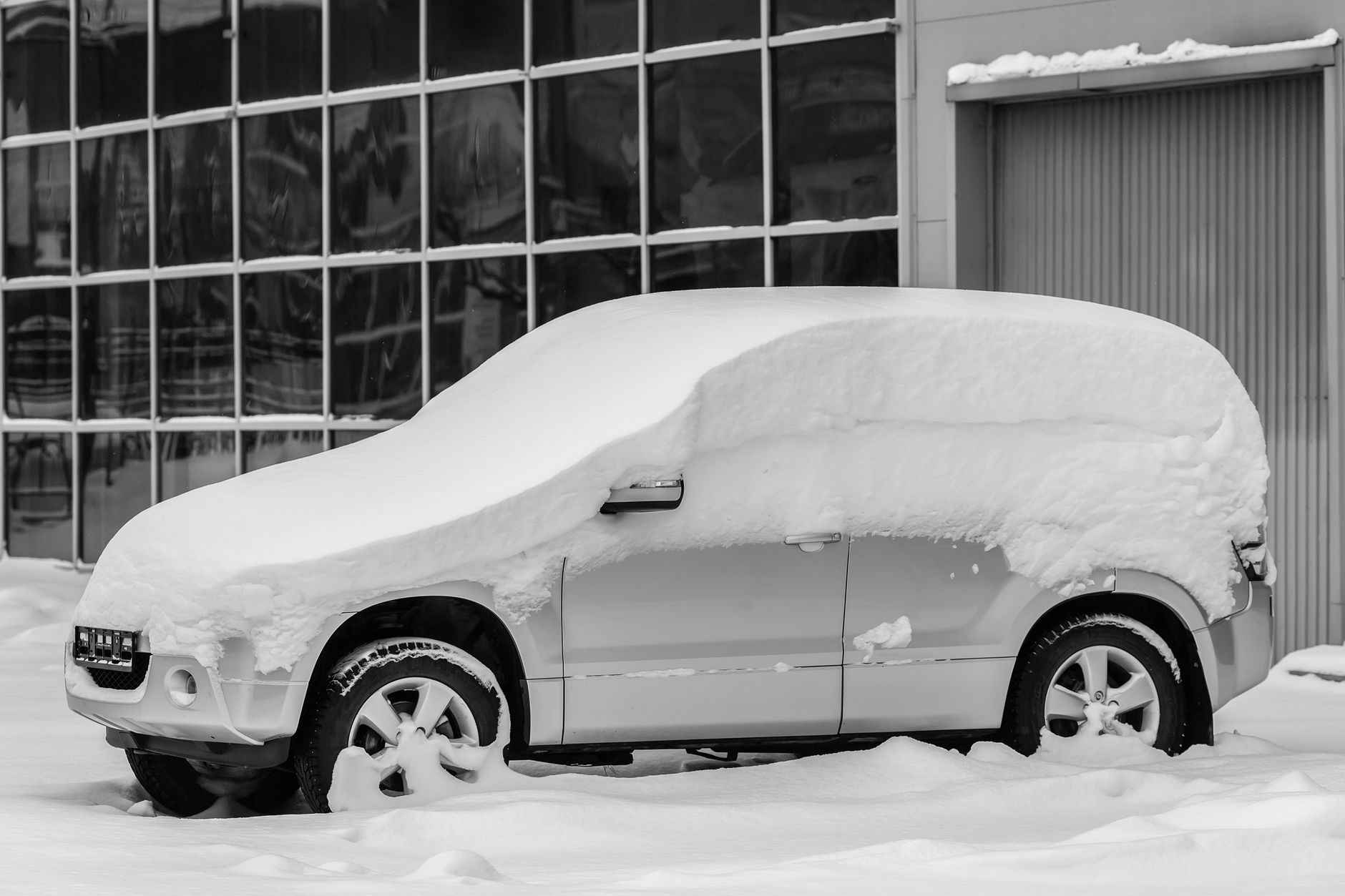
Flooring the accelerator spins the tires and digs them deeper. JAF advises moving slowly back and forth to pack down the snow around the tires, and scattering gravel from a roadside gravel box under the drive wheels if there is one. If that fails, call for help.
While you wait, keep the exhaust pipe clear. JAF warns that snow blocking the exhaust can cause carbon monoxide poisoning, so clear enough snow for it to vent, and open a window from time to time.
Phone numbers to save
- Your rental company’s emergency number, from the rental agreement. Call it before arranging any repair or tow yourself; Toyota, for example, routes tire trouble through a designated insurer’s road service.
- JAF Road Service: 0570-00-8139, or #8139. Many services are free for JAF members; Toyota rents out a JAF membership certificate for ¥550.
- Ambulance and fire: 119. Police: 110.
Road closures and cancellations
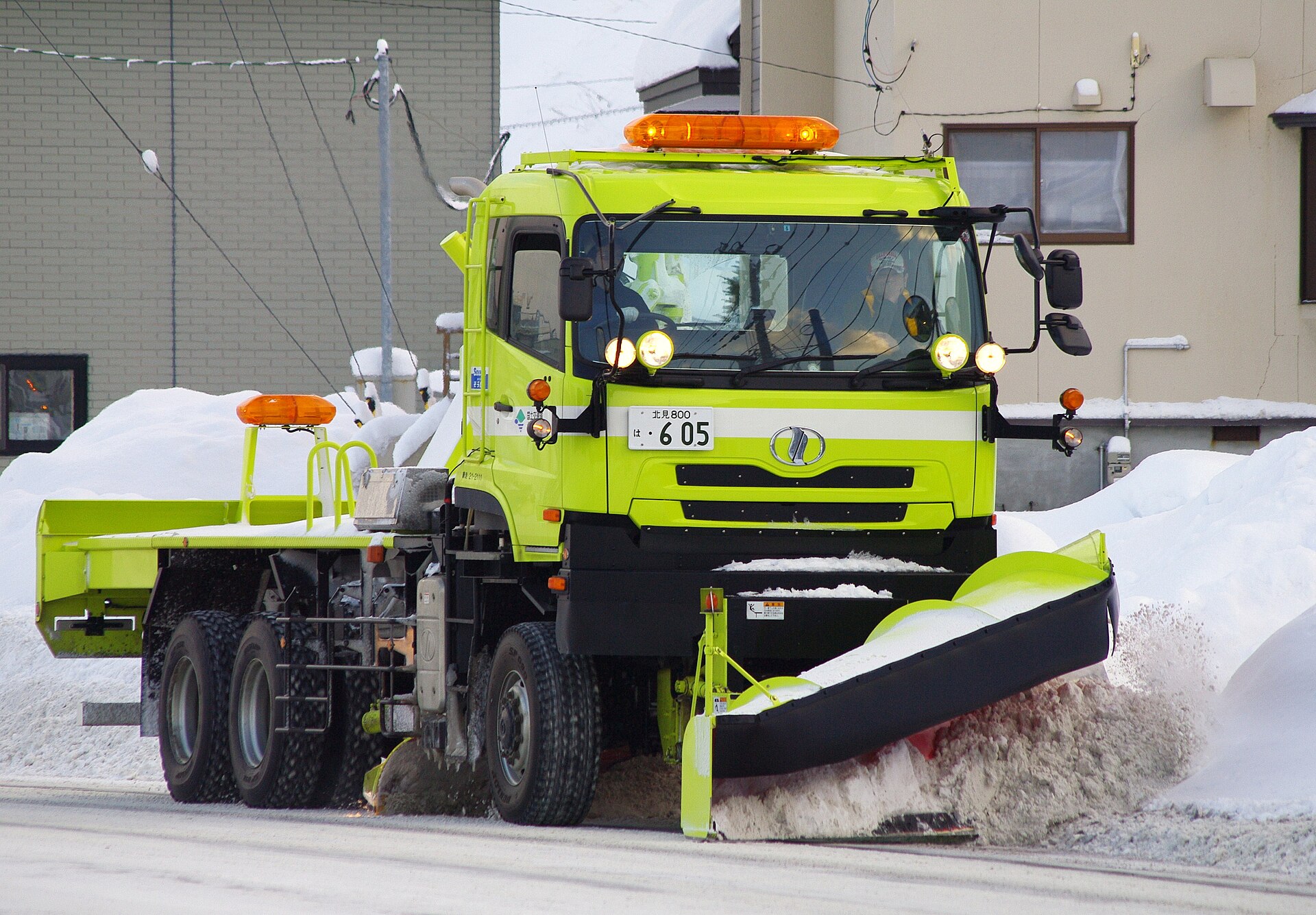
When a strong low-pressure system arrives, expressways and passes close and trains and buses are cancelled. Keep a spare day and avoid a long drive on the day of your flight home.
Sources: JAF: Call Road Service / JAF: Emergency measures / Toyota: insurance
Getting there
Rental cars at New Chitose Airport are not handed over at the terminal. You check in at the rental counter, and each company takes you by shuttle bus to its office in Chitose City, and back again when you return the car. Counter hours differ by company, so check yours against your landing time.
- Nippon Rent-A-Car: 7:00–22:00
- Toyota Rent a Car (Poplar and Suzuran branches): 8:00–20:00
- Times Car Rental: 9:00–19:00
- Honda Rent-A-Car and JR Hokkaido Rent-A-Car: 9:00–18:00
The airport says these hours can change. If your flight lands near closing time, take the train or bus to your hotel and pick up the car the next morning in daylight. In the international terminal, the transportation information counter is on the first floor and the Hokkaido Tourist Information Center, with help in several languages, is on the second.
Source: New Chitose Airport: Rental Cars / Car Sharing
Tips for international visitors
Bring the paper IDP (or your license and its Japanese translation) and your passport to the counter, and keep the passport with you while you drive. Toyota’s online bookings are paid by credit card on the web, and ETC tolls are settled at return.
Toyota’s passenger cars have multilingual navigation, but a phone with data still helps for weather, closures and calling for help. If your plan is data only, check how you would call the rental company and JAF; JAF notes that #8139 does not work from some IP phones.
A Japan eSIM can be bought before you fly and set up on arrival, so maps, weather and road closures are on your phone from the airport. Check whether the plan includes a phone number, since the rental company and JAF are reached by phone.
JAF advises booking early for busy periods such as the year-end and New Year holidays, when much of Japan is off work. Reserve 4WD at the same time, since not every shop has it.
FAQ
Foreign visitors can rent a car in Hokkaido in winter with a 1949 Geneva Convention International Driving Permit (or, for six countries, a license with a Japanese translation), and winter tires are standard at the major rental companies in season. Ice is the harder part: in JAF tests a car needed about 84 m to stop from 40 km/h on ice, so winter driving in Hokkaido suits people who already drive on snow at home.
Is it safe to drive in Hokkaido in winter as a foreigner?
Driving in Hokkaido in winter is manageable if you already drive on snow and ice at home, stay on main roads and finish before dark, which is around 16:00 in December. It is a poor place to drive on snow for the first time: in JAF tests a car needed about 84 m to stop from 40 km/h on ice, against about 20 m on packed snow.
Do I need an International Driving Permit to rent a car in Hokkaido?
Yes, unless your license is from Switzerland, Germany, France, Belgium, Monaco or Taiwan, in which case you need the license plus a Japanese translation. The IDP must be issued under the 1949 Geneva Convention; JAF states that IDPs under other treaties, such as the 1968 Vienna Convention, are not valid in Japan. Nippon Rent-A-Car refuses copies and digital permits, and Toyota Rent a Car asks for your passport as well.
Are winter tires included with Hokkaido rental cars?
Yes. Winter tires are standard on Hokkaido rentals in season at the major companies: Toyota Rent a Car from November 1 to May 5, and Nippon Rent-A-Car from November 1 to April 20. Both add a winter seasonal charge. 4WD is not always included; Toyota sells it as an option at ¥1,650 per 24 hours.
Is 4WD necessary in Hokkaido in winter?
4WD helps a car pull away and climb hills, but it does not shorten braking distances. In a JAF test only the 4WD cars climbed a 20% slope on packed snow, yet on a 9% downhill they took longer to stop than the 2WD cars. Choose 4WD if your route has hills, and drive as if you cannot stop quickly.
Summary
Driving in Hokkaido in winter suits visitors who already drive on snow and ice, stay on main roads and finish before dark, which is around 16:00 in December. Visitors without that experience can reach the cities and ski resorts by train and bus.
- Rent only if you already drive on snow and can keep to main roads in daylight. Cities and ski resorts are reachable by train and bus.
- Bring a 1949 Geneva Convention IDP (paper booklet), or for six countries your license with a Japanese translation, plus your passport with an entry stamp.
- Winter tires are standard in Hokkaido in season. Check 4WD, the damage waiver and NOC cover when you book.
- Watch for black ice, polished ice at intersections, bridges and tunnel exits. Avoid mountain passes and finish before dark.
- Save the rental company’s number, JAF’s #8139, 110 and 119, and keep a spare day for storms.
Braking distances are JAF test results under the stated conditions; real distances depend on the road, the car and the speed. Rental prices, cover and winter periods can change, so confirm them with the rental company before you book.